Amia.ai
Services as software for life sciences

Regulatory and validation work, delivered.

Amia delivers the finished work, with strategy included. Our MedNova software does the analysis, and expert reviewers confirm every finding before it reaches you. You receive the deliverable, not another tool to learn.

Expert-led, software-assisted

Software drafts. Experts decide. You receive work you can stand behind.

Why Amia

The status quo, in numbers.

Where the industry stands today.

Speed

About 6 months

to prepare an IND

Cost

$51K to $300K

total to write and draft an IND

Accuracy

Nearly 100%

regulatory compliance of AI-drafted trial documents, up from 70 to 80% for a general-purpose chatbot

FDA AI, aka Elsa

2025

FDA launched Elsa, its agency-wide AI tool, in June. Agentic AI followed in December.

Why now

Regulators now review with AI.
Sponsors are still filing blind.

“Submissions that are disorganized, that bury key data, or that require reviewers to synthesize inputs may fare poorly when the first pass is algorithmic.”
Steve Silverman, former Director, FDA CDRH Office of Compliance · What the FDA?
“Elsa's algorithms may detect patterns or anomalies that human reviewers might overlook, leading to new types of information requests or queries that are more data-driven or granular.”
Kimberly Chew, Odette Hauke & Kathleen Snyder, regulatory attorneys and consultants · Clinical Leader

Their advice: anticipate likely questions and supplement your initial filing with responsive data before submission. Agency officials at the 2026 FDLI Annual Meeting were just as direct: expect AI to be applied to your submission and prepare accordingly, per Skadden's meeting report.

If an algorithm reads your filing first, have your filing checked before you send it. That is the work we deliver.

Services

Everything we deliver, across the lifecycle.

Regulatory and validation work on one source-linked foundation. Every statement traces back to your documents and to public sources, and an expert reviews it before it reaches you.

Regulatory

  1. Before you file

    IND gap assessmentPrioritized gaps across CMC, nonclinical, and clinical, with predicted reviewer questions labeled as predictions and a recommended action for each gap.
  2. Writing the IND

    IND generationIND sections drafted from your source data, with each statement traceable to where it came from, then reviewed and edited by an expert.
  3. In the clinic

    Clinical summary reportsClinical data summarized from your study documents, with figures and statements traced back to the source tables and listings.

Validation

  1. Before execution

    Protocol generationValidation protocols, such as IQ, OQ, and PQ, drafted from your validation plan and requirements.
  2. After execution

    Report generationValidation reports drafted from your executed results, with each statement traced to the data behind it.
  3. Any time

    Documentation reviewCompleteness, cross-document consistency, and requirement-to-test traceability checks on documents you already have.
Strategy includedAt every stage, our experts advise on what to do next. It is part of the fee.
How it works

Software first.
People before anything reaches you.

  1. Step 1

    Scope

    We agree the documents, the question you need answered, and the review cycles included, in writing.

  2. Step 2

    Analyze

    MedNova runs rule checks, retrieves evidence from your documents and public sources, and drafts findings with their sources attached.

  3. Step 3

    Review

    A regulatory or validation expert confirms, edits, or removes each finding. Nothing is delivered on software output alone.

  4. Step 4

    Deliver

    You receive the finished work, our strategy recommendations, and a call to walk through it, so your team can act on it.

The software does

  • Deterministic rule checks, kept separate from AI-assisted reasoning
  • Retrieval of evidence from your documents and public sources
  • First-draft findings with a source attached to each one

People do

  • Decide which findings are real and how serious they are
  • Own the final report you receive
  • Answer your questions and walk your team through it

We do not

  • Claim to reproduce or approximate FDA's internal systems
  • Predict every question a reviewer will ask
  • Treat "not located" as proof that evidence does not exist
What you receive

A finding you can act on,
not a score to interpret.

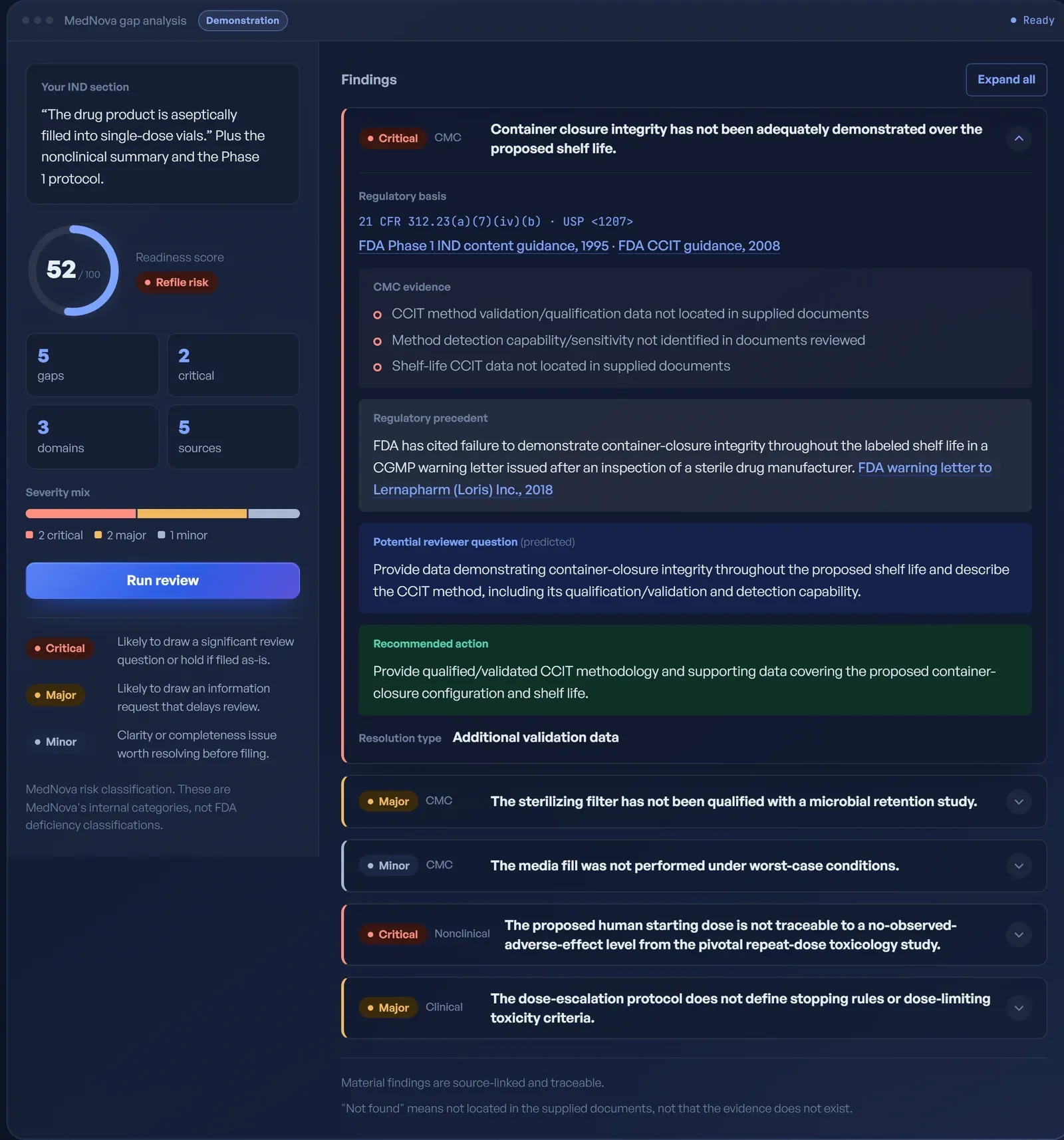
Three findings from an illustrative gap assessment of a hypothetical sterile injectable IND. Each one states the gap, its basis, what was and was not located, and what to do next.

Critical CMC

Container closure integrity has not been adequately demonstrated over the proposed shelf life.

Regulatory basis
21 CFR 211.166 · USP <1207> · FDA CCIT guidance, 2008
CMC evidence
CCIT method qualification data not located in supplied documents. Shelf-life CCIT data not located in supplied documents.
Regulatory precedent
FDA has previously raised container-closure integrity deficiencies in regulatory reviews. FDA warning letter, 2018
Recommended action
Provide qualified CCIT methodology and supporting data covering the proposed container-closure configuration and shelf life.
Critical Nonclinical

The proposed human starting dose is not traceable to a no-observed-adverse-effect level from the pivotal repeat-dose toxicology study.

Regulatory basis
21 CFR 312.42(b)(1)(i) · 21 CFR 312.23 · FDA maximum safe starting dose guidance
Nonclinical evidence
NOAEL determination for the most sensitive species not located in supplied documents. Human equivalent dose scaling calculation not identified in documents reviewed.
Recommended action
Provide the NOAEL for each species with supporting toxicokinetic exposure data, and document the human equivalent dose derivation and safety factor applied.
Major Clinical

The dose-escalation protocol does not define stopping rules or dose-limiting toxicity criteria.

Regulatory basis
21 CFR 312.42(b)(1)(i) · 21 CFR 312.42(b)(1)(iv) · FDA grounds for clinical hold
Clinical evidence
Dose-limiting toxicity definition not located in supplied documents. Cohort-level escalation and de-escalation rules not identified in documents reviewed.
Recommended action
Add an explicit definition of dose-limiting toxicity and the criteria for escalating, holding, de-escalating, and stopping dosing.
Screenshot of the MedNova demo workspace. A readiness panel on the left, and on the right a critical CMC finding on container closure integrity, with its regulatory basis, evidence not located in supplied documents, a predicted reviewer question, and a recommended action.
Screenshot of the MedNova demonstration workspace, using a hypothetical sterile injectable IND and demo data. In our service, an expert reviews every finding before it reaches you.

Illustrative example. Critical, Major, and Minor are Amia's own risk classification, not FDA deficiency classifications. "Not located in supplied documents" means the item was not found in what was provided, not that the evidence does not exist.

Who it is for

For biotech, pharma, and CRO teams.

Biotech

Lean teams that need the filing done and checked without hiring a regulatory function first.

  • A defined scope and fixed fee, quoted before work starts
  • No new software to learn or staff to add
  • Strategy included in the fee

Pharma

Teams that need documents an auditor can follow from the page back to the source.

  • Source-linked findings and generated text
  • Deterministic checks kept separate from AI-assisted reasoning
  • Deployment in your cloud or on premise, by arrangement

CROs and CDMOs

Service providers that need sponsor-ready documents without adding headcount.

  • Documents delivered to a scope you and the sponsor agree
  • Validation protocols and reports for your systems
  • Reviewed by an expert before it leaves you
Pricing model

Pay for the deliverable,
not the seat.

There is no license to buy and no software for your team to operate. Each engagement is a defined scope for a fixed fee, quoted on a scoping call.

Scope in writing

The documents reviewed, the review cycles included, and the format of the deliverable are agreed before work starts.

One fee per deliverable

No seats, no per-page meter, and no open-ended hours. You know the cost before we begin.

Strategy is included

Regulatory and validation strategy from our experts is part of the fee. You get direction on what to do next, not only documents.

Fixing is scoped separately

A fixed fee for the assessment does not imply unlimited remediation. Follow-on work is scoped on its own terms.

Trust

Built for work
you have to defend.

Traceable and reviewed

  • Source-linked and traceableMaterial findings are source-linked and traceable, so your team and your auditors can follow each one back to where it came from.
  • People sign offAn expert reviews every finding and every generated document. The software drafts and checks; accountable people decide.
  • Honest about absenceWe write "not located in supplied documents," not "does not exist," unless we have authoritative knowledge that it does not.

Responsible by design

  • Two kinds of checks, labeledDeterministic rule checks and AI-assisted reasoning are kept separate, and the report tells you which produced which finding.
  • Your documents stay yoursData handling is configured to your enterprise and GxP controls. Deployment in your cloud (AWS, Azure, or GCP) or on premise is available by arrangement.
  • Public sources, namedFindings draw on public FDA, EMA, and ICH guidance and regulations, ClinicalTrials.gov, Drugs@FDA, and PubMed, alongside the documents you supply.
Questions

Questions before you book.

Do we need to learn or operate any software?

No. You send the documents in scope and receive a finished report. MedNova supports the work behind the scenes and behind expert review.

Who reviews the findings?

A regulatory or validation expert confirms, edits, or removes each finding before delivery. Software output alone is never the deliverable.

Does this tell us what FDA will ask?

No one can know that in advance. Reviewer questions in our reports are labeled as predictions, and every gap is tied to a source. We do not claim to reproduce or approximate FDA's internal review systems.

What do we need to send?

The documents in scope. For a gap assessment, that is typically the IND sections you have drafted, the nonclinical summary, and the protocol. For IND generation and clinical summary reports, the source data and study documents. For validation, your validation plan, requirements, and executed results, or the protocols and reports to be reviewed. We confirm the list on the scoping call.

How is it priced?

A fixed fee for a defined scope, quoted after a scoping call. Strategy is included in that fee. There are no seats or licenses.

Does this replace our regulatory team?

No. It gives your team a source-linked starting point so they spend time on judgment instead of searching. Accountability for the submission stays with you.

Know where you stand
before you file.

Tell us what you are about to submit. We will tell you what a finished assessment would cover and how it would be scoped.

Book a scoping call